

The Denim Essay
in red and white and blue

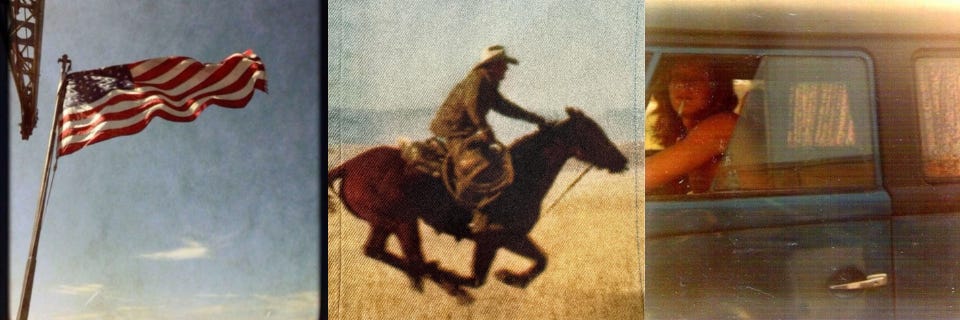
Across the universe and in what they call the heavens stretches a banner of red, white, and blue, once impossible, now fading in the daylight. The sun pierces through it, whipping and snaking back in on itself as the wind, a clean and desperate violence, hangs above a highway that stays deceptively still. One corner has begun to unravel. The same loose thread keeps catching the heavy Tennessee heat, lifting into the air before disappearing against a blank sky. The grommets scrape against the hollow aluminum pole with a sound like dry bone, a steady, rhythmic ticking that fills the middle of the afternoon. One watches it and understands, with a chilling precision, that this frantic choreography has outlived whatever conviction originally animated it. In the end, it tells you nothing about the nation and only about the pressure of the weather… which is precisely how I came to think about a silent, frenzied collapse hiding in plain sight during the summer of 2024.
America is always wearing itself out. Whether it lives or dies, it almost always comes back in denim because nobody dreams in polyester. They dream in faded blue jeans.
Boarding-pass ink gets rubbed onto the inside of a front pocket after one too many rides down Route 66. Belt loops get stretched out from being pulled on in gas station bathrooms somewhere between Arizona and Tennessee. Frayed hems turn pale from years of dragging across beaten asphalt. Dust settles into the creases of leather boots. The jacket thrown over the back of a diner booth at two in the morning still smells faintly of bonfire smoke after summer has ended. Motel lights buzz beside a Coca-Cola vending machine that no longer works. The glowing cadence of fireworks shimmers in the windshield instead of the sky. A brick-red, banged-up Ford pickup vanishes behind a roadside bar.
Speeding down a road and disappearing into heat waves.
Rock and roll spilling from blown speakers somewhere farther down the interstate.
A full tank of gas.
The windows rolled halfway.
Ashing Camel Blues beside the rearview.
Enough miles to forget where you started. Enough horizon to keep driving.
This is the sound of closing your eyes while you dream of the American dream, but when will you forget to open them?
Two summers ago, I took a purple city bus from somewhere in Green Hills back to somewhere in the Gulch. I don’t think it was the Seventeen and it wasn’t the Seven, but some other route running by accident, cleaning up the mistakes of a bus that hadn’t come hours earlier. Jacob and I stood outside for a while before it arrived, feeling the evening air begin to swallow the late July heat. Inside, the new shift driver sat on one of the front benches. He carried deep, exhausted shadows beneath his eyes and a black rag over one shoulder, worn thin and stained with bleach. Around ten he asked a passenger with a familiar face whether he had finished doing time.
He had.
And whether he’d gotten clean.
He had. He moved his family into a one-bedroom apartment, and started a small business.
The driver, speaking in increasingly passionate bursts interrupted by moments of sharp, hitching gasps and strangled sobs, confessed that he had lost his son, my age. At some point he died when another drug of choice disappeared beneath fentanyl and he happened to be spending too much time alone. With every passing quarter mile, with every flicker of orange streetlamp strangled by overhead pines came a new detail. Maybe he picked it up on the wrong side of the street. Maybe he pushed the dose just over the edge. Maybe he wanted it exactly that way. In any light, he died of some asphyxia of the most deserted kind, that much I know.
That summer was lined with Stop Fentanyl billboards. Some carried the names and faces of recent overdose victims. Others offered motivational slogans or Christian Bible verses. The bus rolled past several of them as we wound through the back roads that night and all I remember is the feeling of Jacob’s sleeve as I gripped the arm of his sweater tighter and tighter. From the driver’s perspective, the moral of the story was cut and dry: stay clean. For me it’s different. What I see are the signs around me and the look of faith in one man’s face as he stares intently into the desperation of another.
All in the midst of that six wheel drive for fifty-five minutes we all sat with disparate lives, squirming in the same blue jeans.
Since then, I’ve started noticing denim everywhere: outside of schoolyards and courthouses and crossing the street. At truck stops. In the TSA checkpoint just before the airport terminals. On musicians loading trailers at one in the morning. On mothers filling their SUV’s with regular. On men asleep in hard hats against bus windows. One fabric, under god, indivisible, with freedom and durability to survive on a million life stories and a million different pairs of legs.
The American Dream has worn a lot of costumes. It was built to be worked in, sweated through, caught on barbed wire, stained with motor oil, grass, beer, lipstick, and blood if necessary. Every once in a while, beneath all the stories we’ve told ourselves, there’s still something honest about a piece of fabric that refuses to stay untouched.
It fades and tears, but it remembers. Maybe that’s all any country can hope to do.
In loving memory of the man I do not know the name of. You live forever, go be free.
Using denim as both a physical object and a national metaphor is nothing short of genius. As you so carefully examine, the American dream isn’t this larger than life idea, but a proof that every individual lives its own, riddled with grief, joy, hardship and everything in between.
This piece genuinely touched something in me.
I'm at a loss of words, this was beautiful piece!